


Law firms are recommended by ChatGPT, Google AI Overviews, and Perplexity based on how clearly their entity information, content structure, and third-party validation signal expertise and trust. As of 2026, 42% of consumers say they would use ChatGPT to help choose a lawyer, up from just 9% in 2023, while a small group of legal directories still controls most AI citations.
Firms that publish direct answer content, implement schema markup, build topical depth around their practice areas, and earn consistent third-party mentions are far more likely to be named when someone asks an AI tool who to call. The Legal Marketing Company builds this kind of AI visibility for law firms nationwide.
Potential clients used to start their search for a lawyer with a Google results page. In 2026, a growing share of them start with a question typed into ChatGPT, Google AI Overviews, or Perplexity instead. They ask which personal injury lawyer to call after a wreck, who handles custody cases in their county, or how one divorce attorney’s fees compare to another’s. The answer that comes back names specific firms and attorneys, and if your firm is not one of the names mentioned, you have lost that client before they ever saw your website.
This shift matters for every practice area, but it matters most for firms that built their marketing programs around traditional rankings alone. Ranking on page one of Google no longer guarantees a mention inside an AI-generated answer.
Getting recommended by AI requires a different kind of visibility, one built on consistent entity information, structured content, and third-party trust signals. This guide breaks down the data behind the shift, what AI systems are actually looking for, and the specific steps your firm can take to become one of the names AI recommends.
Why AI Search Is Different From Traditional SEO
Traditional SEO earns your firm a position on a results page. AI search earns your firm a mention inside a generated answer, and those are two different goals that respond to two different sets of tactics.
Google AI Overviews, ChatGPT, and Perplexity are not ranking your website the way a traditional search engine does. They are synthesizing an answer from many sources at once and deciding which firms and attorneys deserve to be named inside that answer.
A firm can rank well in traditional search results and still be left out of the AI-generated response entirely, which is why this work is often described as AEO (answer engine optimization) and GEO (generative engine optimization) alongside traditional SEO. The three disciplines overlap, but AEO and GEO require their own content structure and their own measurement.
The Data: How Fast Legal Consumers Are Moving to AI
The shift toward AI-assisted legal research is not a theory. It is measurable, and the numbers are moving quickly.
According to a 2026 consumer research study from iLawyer Marketing covering 1,110 U.S. consumers, the share of people who say they would use ChatGPT to help research which lawyer to hire has grown more than four and a half times in three years. Meanwhile, reliance on Google alone to find an attorney dropped 15 percentage points in a single year, falling from 86.7% in 2025 to 71.9% in 2026 as more of that research activity moved into AI answer engines. Half of the consumers surveyed said they would now use at least one AI answer engine as part of their attorney search.
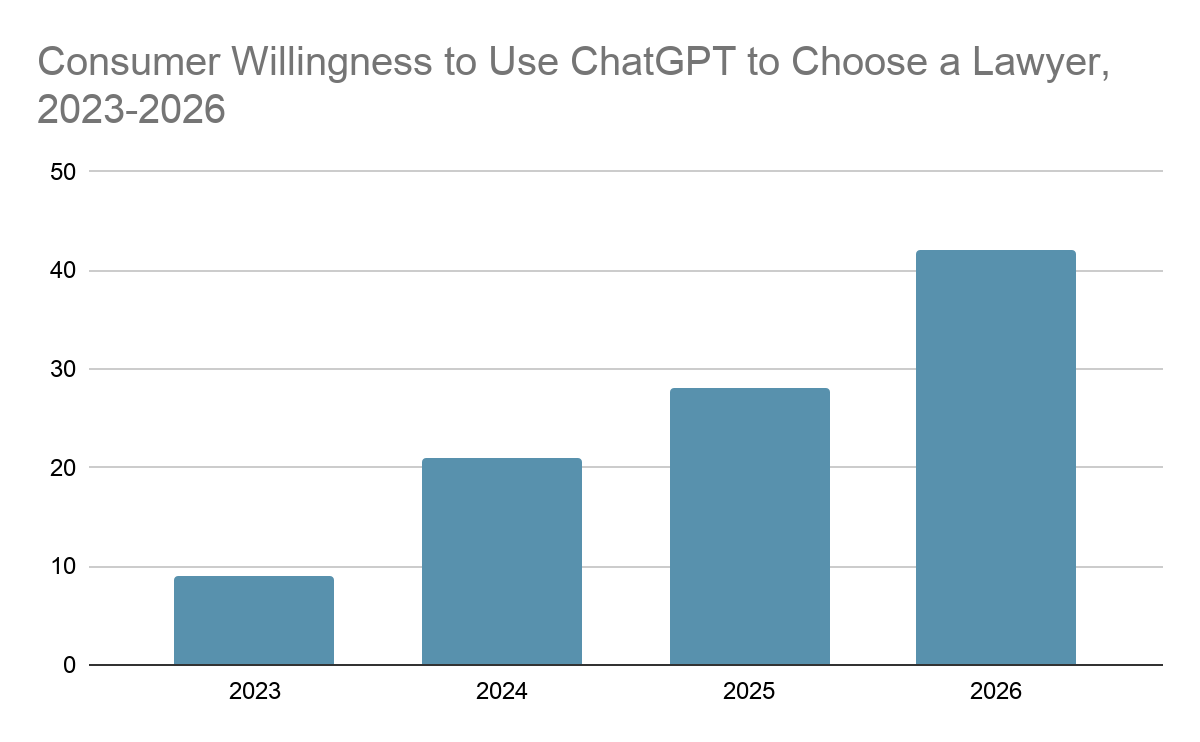
Figure 1. Share of U.S. consumers who say they would use ChatGPT to help decide which lawyer to hire, 2023 to 2026. Source: iLawyer Marketing 2026 Consumer Research Study.
The adoption curve is not limited to younger, tech-forward consumers either. The same study found that adults between 45 and 60 are leading AI adoption in legal research, with 57% saying they would use ChatGPT specifically and 76% saying they would use some form of AI when researching a law firm. That age range includes a large share of the clients who generate the highest value cases in personal injury, divorce, and estate planning, which means this is not a niche behavior firms can afford to wait out.
The Adoption Paradox: Lawyers Use AI, Clients Still Cannot Find Them
While consumers move toward AI to find legal help, the legal industry itself has become one of the most internally AI adopted professions in the country, and that creates an unusual gap.
Per Clio’s 2025 Legal Trends Report, 79% of legal professionals now use AI tools in their daily work, with adoption reaching 87% at large firms and 71% at solo practices.
Yet that same industry remains largely invisible to the AI tools consumers are using to find legal help. Independent research from the 2026 Legal AI Visibility Report, published jointly by Haute Lawyer Network and 5W, found that roughly seven directories- Chambers, Legal 500, Super Lawyers, Best Lawyers, Martindale, Avvo, and Justia dominate the answers AI systems give across nearly every legal query category tested.
Individual law firm websites, including some of the most well-known firms in the country, consistently appear behind these directories rather than as the primary source AI cites.
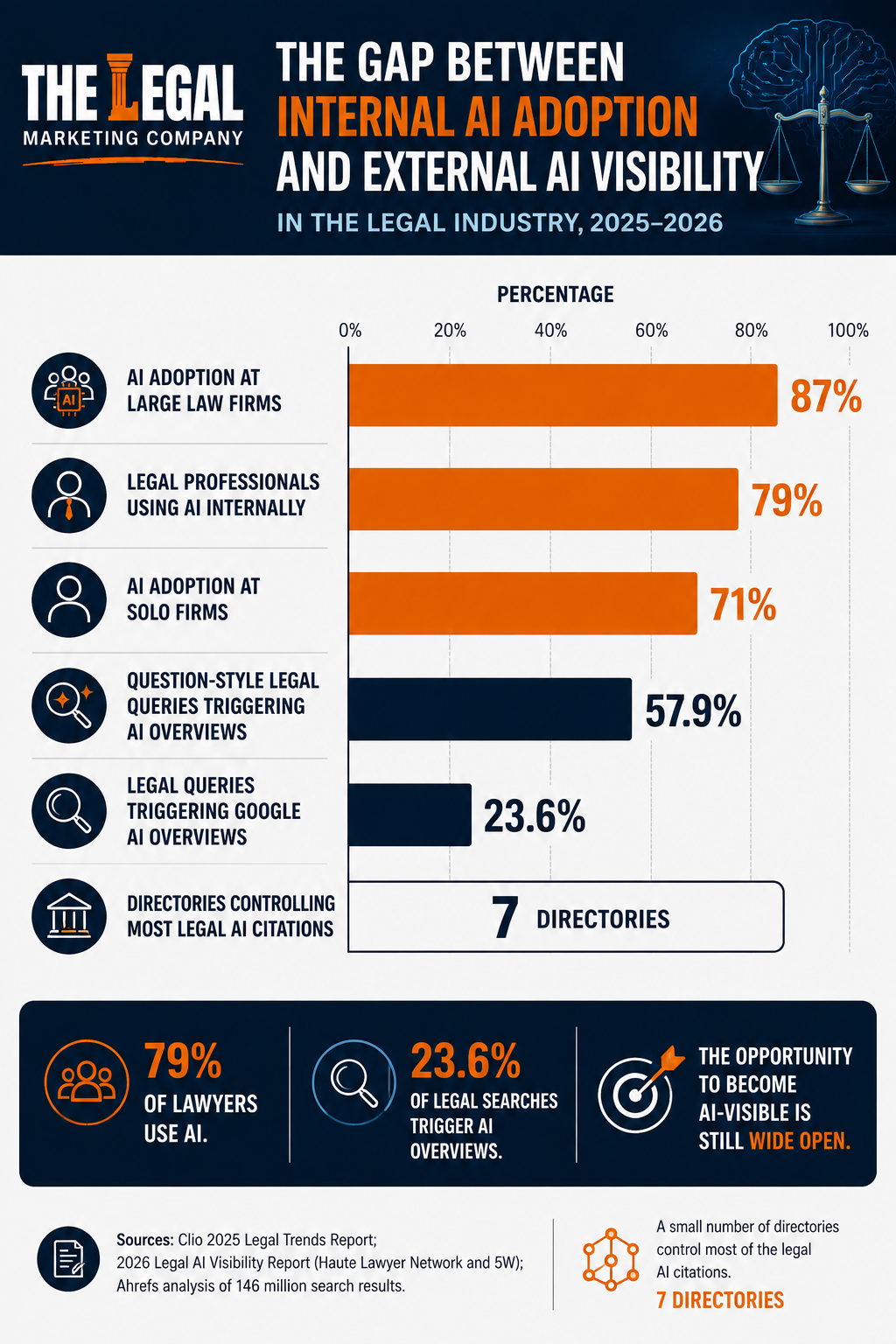
Figure 2. The gap between internal AI adoption and external AI visibility in the legal industry, 2025 to 2026. Sources: Clio 2025 Legal Trends Report; 2026 Legal AI Visibility Report (Haute Lawyer Network and 5W); Ahrefs analysis of 146 million search results.
The firms that close this gap first, building their own AI visibility rather than relying on directory listings alone, are positioned to capture a disproportionate share of the clients now searching through AI.
What ChatGPT and Google AI Overviews Actually Look For
Large language models and AI Overviews pull from patterns across the entire web rather than a single page, and they generally look for the same handful of signals before naming a specific firm.
Consistent Entity Information
Your firm name, attorney names, practice areas, and location need to match exactly across your website, directories, and citations. Inconsistent information confuses the entity matching these systems depend on, and confusion usually means your firm gets left out of the answer rather than named incorrectly.
Direct Answers Near the Top of the Page
AI systems favor content that states a clear answer within the first sentence or two, then supports it with detail. A page that answers a real client question immediately is more likely to be pulled into a generated response than a page that opens with a general introduction before making its point.
Structured Data
Schema markup, particularly LegalService, Attorney, and FAQPage schema, gives these systems a machine-readable confirmation of who you are, what you practice, and where you are located. It is one of the most overlooked levers in AI visibility work.
Topical depth
A single blog post about car accidents will not carry the same weight as a full content library covering car accidents, motorcycle accidents, pedestrian accidents, wrongful death claims, and the specific statutes that govern each. AI systems reward firms that demonstrate depth across a practice area rather than a single page built around one keyword.
Third-Party Validation
Reviews, legal directories, press mentions, and citations from other authoritative sites all feed the trust signals these models weigh. This is part of why E-E-A-T (experience, expertise, authoritativeness, and trust) still matters in an AI-driven search environment, and it is also why the directory concentration described above is such a significant hurdle for individual firms to overcome.
The Seven Directory Problem
Across every query type tested in the 2026 Legal AI Visibility Report, a small set of ranking directories dominates the legal AI citation layer. For finder queries such as best personal injury lawyer in a given city, Super Lawyers consistently owns the top position, with Justia, Avvo, Martindale, and FindLaw filling out the tier below it. Individual law firm websites typically appear beneath all of these, even when the firm itself is well known in its market.
| Directory | Typical Role In AI Citations |
| Super Lawyers | Frequently the top cited source for finder style queries |
| Justia | Common secondary citation across most practice areas |
| Avvo | Strong presence in attorney profile and review based answers |
| Martindale | Weighted heavily for credentialing and peer review signals |
| Best Lawyers | Cited most for elite or specialty practice area queries |
| Chambers | Dominant source for large firm and corporate practice queries |
| Legal 500 | Parallel authority to Chambers for international and complex matters |
Figure 3. Seven directories that dominate AI generated legal citations across finder, elite, and specialty queries, 2026. Source: 2026 Legal AI Visibility Report, Haute Lawyer Network and 5W.
A case example from the same report makes the point clearly. When researchers searched a well known M&A firm’s name paired with its own practice area, the top results were directory profiles rather than the firm’s own website, even though that firm’s content should have been the most relevant result available. If AI systems will not consistently surface a top ranked national firm’s own content over a directory listing, smaller and mid sized firms need an intentional strategy to compete for citation space at all.
A Step-by-Step Plan to Get Your Firm Recommended by AI
Closing the gap between internal AI use and external AI visibility comes down to seven concrete steps.
- Audit your existing content for direct answer structure. Review your top service pages and blog posts. Do they answer the core question in the opening sentences, or do they build up to the point through a general introduction. AI systems favor the former.
- Build topic clusters, not standalone pages. Every practice area should have a pillar page supported by pages on related questions, local nuances, and specific case types. This signals genuine topical depth rather than a single optimized page.
- Implement schema markup site-wide. LegalService schema on your homepage and service pages, Attorney schema on each lawyer’s bio, and FAQPage schema on pages that answer common questions all give AI models a faster, clearer way to confirm your firm’s relevance.
- Standardize your firm’s information everywhere it appears. Name, address, phone number, attorney names, and practice areas should match exactly across your website, Google Business Profile, legal directories, and press mentions. Small inconsistencies slow down or block entity recognition entirely.
- Publish content built around real client questions. Think about what a person actually types or asks when searching for a lawyer. Questions such as how long do I have to file a workers compensation claim or what happens at a custody modification hearing make far better AI facing content than generic keyword pages.
- Earn mentions on authoritative third party sites. Legal directories, bar association pages, local news coverage, and guest contributions all strengthen the trust signals AI systems use to decide who to recommend, and they help offset the directory concentration described earlier.
- Track your AI visibility the same way you track rankings. Periodically ask ChatGPT, Google AI Overviews, and Perplexity the questions your clients would ask. Note whether your firm is named, which competitors and directories are named instead, and adjust your content and citations accordingly.
Why the Stakes Are Higher for Law Firms
Legal services fall under what Google classifies as YMYL, or Your Money or Your Life, content. AI systems apply extra scrutiny to YMYL topics because the cost of a wrong recommendation is high, and a firm that clearly demonstrates experience, expertise, authority, and trust has a real advantage over a firm that has only optimized for keywords.
This also means shortcuts carry more risk in the legal space than almost anywhere else online. Thin content, fabricated statistics, or inconsistent firm information will not just fail to rank, it can actively keep AI systems from citing your firm at all. The risk runs in both directions too. Courts recorded 487 instances of AI-generated errors or hallucinations in filings during 2025, more than ten times the 2024 total, and licensed attorneys were involved in 37.8% of those filings. The same technology that can help your firm get discovered can damage your reputation if it is used carelessly inside your practice.
How The Legal Marketing Company Builds AI Visibility for Law Firms
We build AI search visibility the same way we build traditional SEO, around a structured content ecosystem, technical implementation, and consistent entity signals, because that is what earns both search rankings and AI-generated recommendations.
Our process for law firm clients includes full technical audits, pillar and cluster content built around real client questions, schema implementation across service pages and attorney bios, and ongoing content production designed to answer the exact questions potential clients are asking AI tools right now. This work sits alongside the SEO, local marketing, PPC, and content programs we have run for law firms for 25 years, backed by a 93% client retention rate in 2025 and an exclusive, one-firm-per-market model that means we are never building AI visibility for your competitor down the street.
If your firm wants to be the answer AI gives when someone asks who to call, we can help you get there.
Talk to us about a custom AI visibility plan for your firm, or call 904-385-9124 to get started.
Frequently Asked Questions
How is AI search different from Google search rankings?
Google search rankings place your website on a results page. AI search, including Google AI Overviews, ChatGPT, and Perplexity, generates a written answer and decides which firms or attorneys to mention by name inside that answer. Ranking well in traditional search does not guarantee a mention in an AI generated response.
Can a small or solo law firm get recommended by AI search tools?
Yes. AI systems reward clear entity information, structured content, and topical depth over sheer website size. A smaller firm with consistent information and well structured content can outperform a larger firm with an inconsistent or thin web presence.
Does schema markup actually make a difference for AI visibility?
Yes. Schema gives AI systems machine readable confirmation of who you are, what you practice, and where you are located. It reduces the ambiguity these systems must resolve on their own, which makes your firm easier to cite accurately.
Will directories like Avvo or Super Lawyers always outrank my firm in AI answers?
Not necessarily, but it takes deliberate work to compete with them. Directories currently dominate roughly seven out of ten legal AI citations, so your firm needs strong entity signals, direct answer content, and third-party mentions of its own to earn a place alongside or ahead of those listings rather than being replaced by them entirely.
How long does it take to see results in AI search?
Timelines vary based on a firm’s current content depth and technical foundation, but building the topical authority and structured data these systems rely on is an ongoing process rather than a one-time fix. Firms that start now, while roughly 24 months of low-cost citation opportunity remain according to the 2026 Legal AI Visibility Report, are better positioned than firms that wait.